45 Years of Experience
The Certified Gateway to the United States Dairy Market
APPLICATIONS
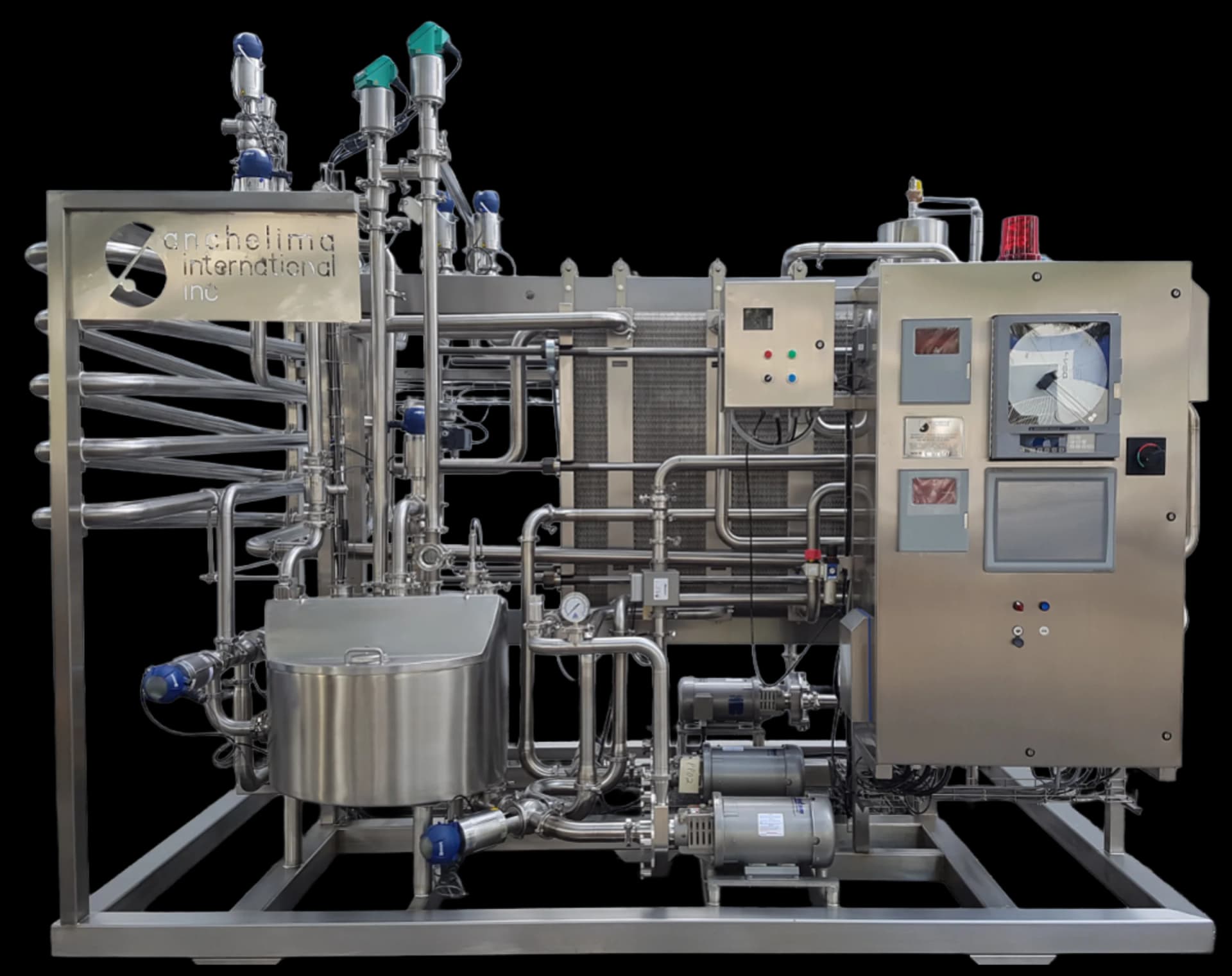
Milk, dairy formulas, flavored milk, creams, ice cream bases, yogurt bases, cream bases, concentrates, juices, syrups, flavored beverages, whey, water, etc.
What does the PMO standard require?
.webp&w=1920&q=75)
PMO REGULATORY COMPLIANCE
STLR (Safety Thermal Limit Recorder) integration — sealed and shielded — acting as the process's 'legal brain', irrevocably recording temperature and every flow diversion event.
REFERENCE INDICATING THERMOMETER (MIG/RTD): Certified reference indicating thermometer, strategically located next to the control probe for immediate visual verification and system calibration.
.webp&w=1920&q=75)
PMO REGULATORY COMPLIANCE
Double-stem Flow Diversion Device (FDD) with 'Fail-Safe' logic and visible leak detection ports, guaranteeing that not a single drop of sub-lethally treated product reaches the cooling section.
.webp&w=1920&q=75)
PMO REGULATORY COMPLIANCE
Positive differential pressure safety system. The PLC logic and transducers guarantee that pasteurized product always has greater pressure than raw product, protecting the final product against cross-contamination in the regenerator.
The system will activate the flow diversion valve if pressure in the raw milk side of the regenerator exceeds a minimum established below the pressure on the pasteurized milk side, thus preventing possible raw milk leaks into the pasteurized milk.
.webp&w=1920&q=75)
PMO REGULATORY COMPLIANCE
Holding Tube isometrically designed with continuous ascending slope for air elimination, ensuring the exact residence time of every milk particle.
.webp&w=1920&q=75)
PMO REGULATORY COMPLIANCE
Positive displacement pumping system with speed controlled by magnetic flow meter, ensuring that flow rate never exceeds the validated limit for pasteurization.
.webp&w=1920&q=75)
PMO REGULATORY COMPLIANCE
Integration of Sanitary Atmospheric Vacuum Breaker Valve (PMO type), strategically located at the highest point of the pasteurized return line.
Guarantees instant gravity drainage of the plates when the equipment stops, eliminating the 'siphon effect' that retains residues. This ensures strict compliance with positive differential pressure (cross-contamination safety) and maximizes CIP cleaning cycle efficiency by preventing chemical dilution.
PROCESS DIAGRAM
.webp&w=1920&q=75)